Ecology
Mother Earth and all her Children
In the western way of doing things, we tend to think of ourselves as the species that stands at the pinnacle of evolution. We got up there rapidly and spectacularly, compared to other forms of life. But not without consequences. The rise of our self-consciousness separated us from nature. Struggling to make sense of the ostensible chaos of the world around us, we created our myths, rules and languages of order, harmony and beauty. Yet, there are living beings on this planet that are far older than us. Plants are at least five hundred million years old while humans have appeared much more recently.
Mother Earth and all her Children
Plants survived aeons of unfathomable hardships and transformations and they are still here, thriving. And they can teach us about functionality, interdependence, symbiosis, adaptability, and resilience. As long as we engage with them, and with all the living beings around us.
Their teachings are not their only gifts. Plants feed us, clothe us, give us shelter, heal us. They are the other half of our lungs. They sustain us. And, although this dichotomy, “they” and “us”, does not help us recover our lost unity with the world, it does help us realise how much we depend on them.
Cycladic plants have wisely adapted to the rough terrain shaped by geological time but also to the semi-arid climate of the islands. Sculpted by the wind, soaked in salt and sun, bracing themselves from drought, overgrazing, fire. Human-driven environmental and climate change are visibly impacting the unique and extremely fragile island ecosystem of the Cyclades. This is not the first time this has happened: whenever humans inhabited the islands, probably for the last 10,000 years, and, proportionally to their numbers and their means, exploited natural resources to sustain their population. Trees became ships and fuel, or were burnt down by invaders with the aim to subdue the inhabitants. In times of scarcity, every inch of land was cultivated or grazed following the seasonal cycles. The Cycladic landscape, ‘topos’, is the map and the chronicle of this interaction between humans and the rest of nature, changing and evolving as are human needs, norms and habits over time.
The valley of Marathi, the location of the ancient marble quarries, like many archaeological sites in Greece, is a magical place. Many would argue that such places have special energy because of their glorious past. I think that part of the magic owes to the fact that they are not frequented by many people, building and many other destructive human activities are prohibited, and, for a brief moment in time, nature is given a little space and is left alone to thrive. And she is giving back, generously, beauty, joy, life. This is why we come back to her, choosing this beauty and this joy and this life, again and again, emphatically and stubbornly.
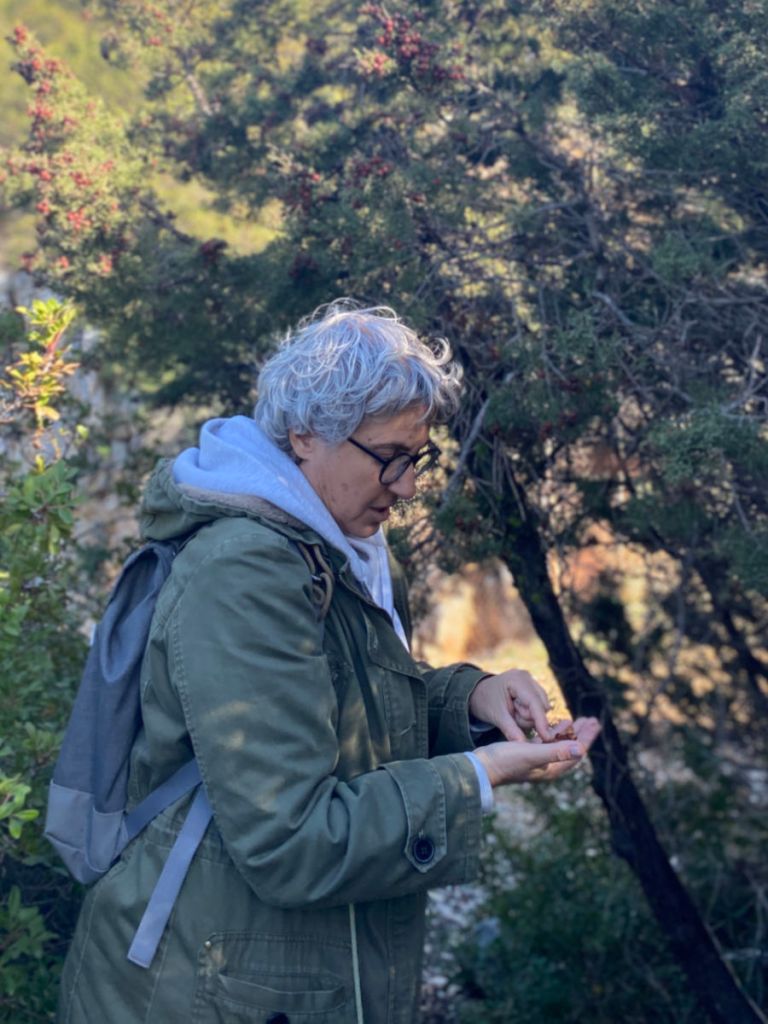
Engineer, Ecologist and Permaculture Designer
Born in Athens, Symeonidou studied electronics and computing engineering as well as cinematography. She worked in film production and advertising in Greece and as a web and multimedia producer at CERN (European Organisation for Nuclear Research) popularising physics for the general public. She studied and practised permaculture and agroecology in three continents (Australia, Asia and Europe), and came to Paros, Greece, to work as an ecology designer, consultant and farmer. She has pursued further postgraduate studies in environmental policy and biodiversity management. For the last few years she has been working on a land regeneration project in Paros Park. Elena has always been interested in understanding how the world works and in sharing what she has learned, by teaching, writing, and, most importantly, by creating concrete examples of restoring living systems.
Further reading from Elena
 Paros Creatives