Sociology – Body Mapping
Embodied Wisdom and Healing
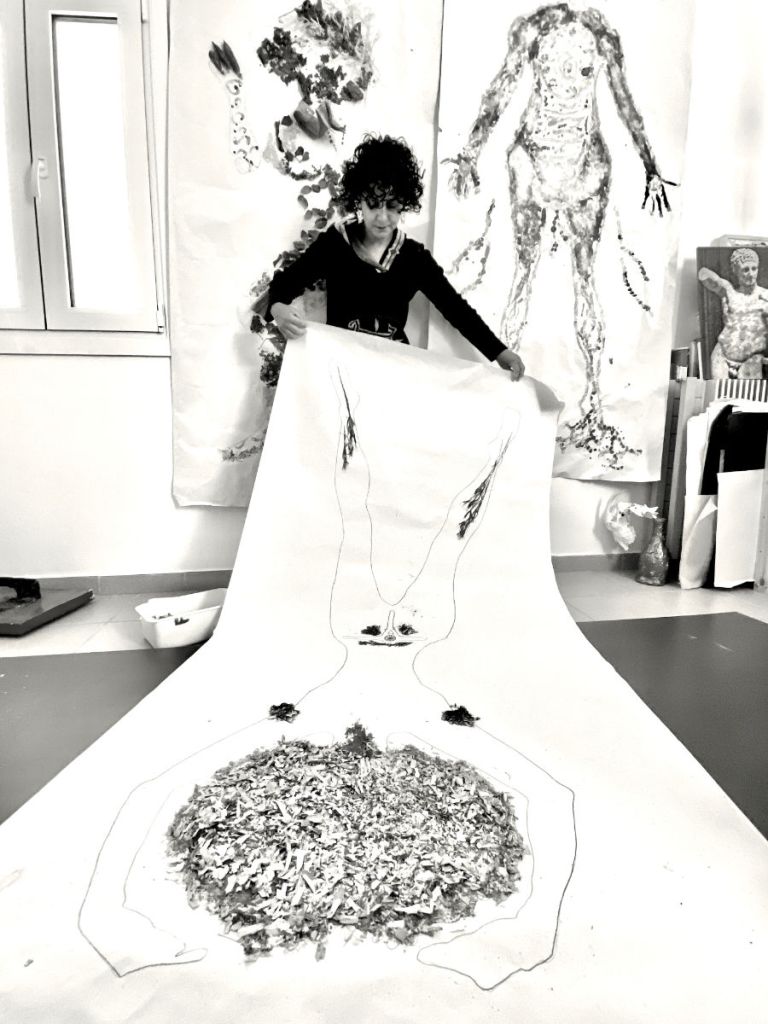
Originating from the discipline of anthropology and commonly used in the social sciences, body mapping is an arts-based approach that involves the tracing of life-size human body images. The body maps represent people’s identities, perspectives and experiences within their social, historical and cultural contexts. Body mapping incorporates drawings of the body to symbolise narratives about oneself connected to specific embodied experiences and memories. The process of body mapping has the power to facilitate healing, while revitalising and redefining our relationship and connection to our bodies, to our land, and to one another.
This interactive body mapping workshop with women of Paros island is informed by the work of artists (mixed-media artist and a sculptor), a sociologist, a geologist, and a local ecologist of Paros island. Works of art and research intersect to explore the ancient quarries, the extraction of the famed Parian marble and the value of local plants as they connect the female topos (landscape) through art, nature and embodied knowledge. Within this context, body mapping with local women in Paros serves to generate knowledge and dialogue about the historical, social and artistic constructions of the island of Paros and ideals of beauty throughout history.
In the context of this project, body mapping is used as a way to tell stories and create visual images about oneself and life, including one’s body and environment. The intent is to help individuals gain a better understanding of themselves, their bodies, environments, communities, and cultures, and the ways in which they are interconnected and intertwined. Participants of body mapping are encouraged to decide what position they want to take for the tracing of their body outline. Then, they are invited to use various objects from nature to decorate and design the inside of their body map, while reflecting upon the connection of their minds, bodies, feelings, thoughts, experiences, natural environment and social interactions. This body mapping process is also informed by the philosophical and artistic concept of the rhizome. The rhizome—botanical and dendrological roots that develop from axillary buds and grow horizontally—symbolise the multiple, non-hierarchical entry and exit points in data representation and interpretation.
In body mapping, participants use images of geological maps and natural elements from the earth found on the island in order to inform the creation of their body maps through the representation of these rhizomatic connections. This process challenges the power hierarchies in place and the socially constructed embodiment of beauty represented in the marble statues of Paros. The collective creation of body mapping images and artefacts provides participants with the opportunity to reflect, represent, redefine, and reclaim ideals of beauty. These body maps acknowledge the feminine and mother Earth, and their interconnection to the eco-cycles of life and the power of gratitude and healing through art. When we touch and embody what is most elemental from nature and from within ourselves, we remember the multi-layered connectedness and rhizomatic embodiment of our relationships and topos.
Professor of Sociology at California State University of Northridge
Born in the USA, Moshoula is a Greek-American scholar-activist-artist from parents who were born and raised on Paros island. After earning her master’s degree and working as a social worker for a few years in California, Moshoula shifted career trajectory and pursued academic research. She received her PhD from Portland State University in 2010. Moshoula’s scholarship and research interests involve the use of arts-based research methodologies as a form of activism for social justice and as a way to highlight the voices of marginalised individuals, groups and communities. Over the past 14 years, she has facilitated numerous community-based, photovoice projects and art exhibits with marginalised populations in California, including sex workers, LGBTQ+ former foster youth, and grandparent caregivers, as well as LGBTQ+ refugees and asylum seekers living in Athens, Greece. Interdisciplinary perspectives inform her community engagement and social activism through the arts.
Further reading from Moshoula
 Paros Creatives